
Class 6 Worksheet on Irregular Plural Nouns

Class 6 Worksheet on Irregular Plural Nouns
Break the Rules Right: Mastering Irregular Plural Nouns for Grade 6
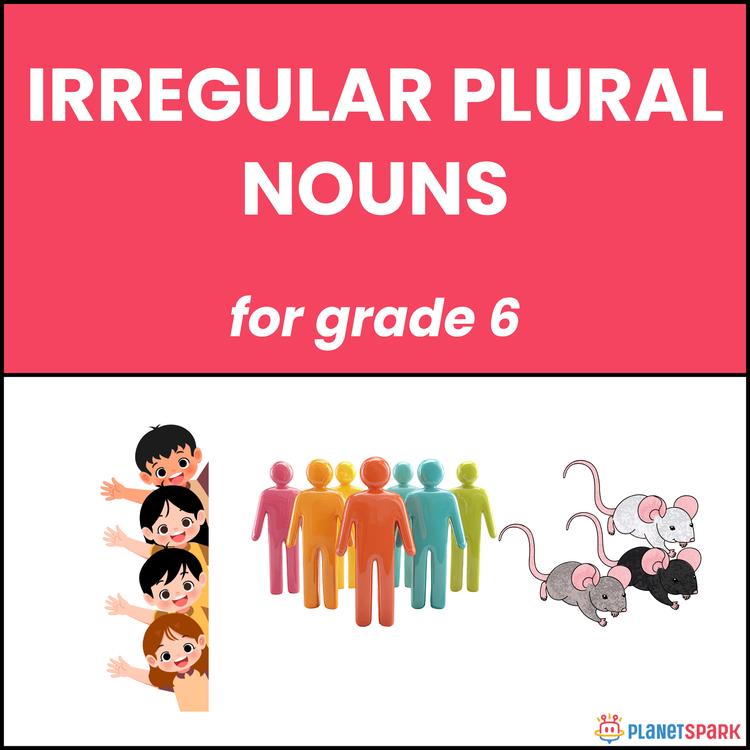
This Grade 6 worksheet helps students master irregular plural nouns — nouns that do not follow the standard "add -s or -es" rule to become plural. Through multiple-choice questions, fill-in-the-blanks, true/false statements, sentence corrections, and paragraph editing, learners understand common irregular patterns like changing "man" to "men," "foot" to "feet," "child" to "children," and "mouse" to "mice," while avoiding errors like "childs" or "mouses."
Why Irregular Plural Nouns Matter in Grammar?
Most nouns simply add -s or -es to become plural, but irregular nouns follow unique patterns. For Grade 6 learners, this topic is important because:
1. Some nouns change vowels (man → men, foot → feet, tooth → teeth).
2. Some nouns add -en (child → children, ox → oxen).
3. Some nouns completely change form (person → people, mouse → mice).
4. Some nouns ending in -f or -fe change to -ves (leaf → leaves, wolf → wolves).
5. Mastering these irregular forms eliminates common writing and speaking errors.
What’s Inside This Worksheet?
This worksheet includes five engaging activities that build fluency with irregular plural nouns:
🧠 Exercise 1 – Multiple Choice Questions
Students read 10 sentences and choose the correct irregular plural form from two options (e.g., "children" vs. "childs").
✏️ Exercise 2 – Fill in the Blanks
Students complete 10 sentences by writing the correct irregular plural form of the given singular noun.
📋 Exercise 3 – True or False
Students read 10 statements about irregular plural rules (e.g., "Mouse becomes mouses in plural") and mark them as true or false.
🔤 Exercise 4 – Correct the Plural Error
Each sentence contains an incorrect plural form. Students rewrite the sentence with the correct irregular plural noun.
📝 Exercise 5 – Paragraph Editing (Irregular Plurals Focus)
Students read a paragraph about a day at the park and correct all errors related to irregular plural noun usage.
Help your child stop guessing between "mice" and "mouses" and start using irregular plurals with confidence.
🔹 Answer Key
Exercise 1 – Multiple Choice Questions
1. b) children
2. b) women
3. a) men
4. b) people
5. a) mice
6. a) babies
7. b) feet
8. b) leaves
9. a) teeth
10. a) tomatoes
Exercise 2 – Fill in the Blanks
1. mice
2. teeth
3. feet
4. leaves
5. men
6. women
7. babies
8. children
9. people
10. wolves
Exercise 3 – True or False
1. True
2. False (Mouse becomes mice)
3. True
4. False (Child becomes children)
5. True
6. False (Man becomes men)
7. False (Baby becomes babies)
8. True
9. True
10. False (Leaf becomes leaves)
Exercise 4 – Correct the Plural Error
1. The women went to the market.
2. I saw many mice in the field.
3. The children played outside.
4. She has two feet.
5. The babies were crying. (already correct)
6. There are three teeth on the table. (already correct)
7. We have many people in the room.
8. The leaves are turning yellow.
9. The men went to work. (already correct)
10. The wolves were howling in the distance.
Exercise 5 – Paragraph Editing (Corrected version)
The women were sitting on the benches, chatting about their families, while their children played in the park. Some of the men were discussing their plans for the weekend, while the feet of the children touched the grass. The sun was shining brightly, and the leaves from the trees were falling gently to the ground. Nearby, a group of babies were playing near a fountain, and the mothers watched them closely. In the distance, a few mice scurried across the path, and some people were walking their dogs. As the day went on, more and more people arrived, and the park was filled with laughter and joy.
Frequently Asked Questions
Irregular plural nouns do not follow the typical “-s” or “-es” pattern, such as “child” to “children” or “mouse” to “mice.”
Irregular plurals don’t follow a consistent rule, so they require memorization and practice.
"Worksheets provide exercises that help reinforce correct forms through repetition and examples.
"