
Class 6 Grammar Worksheet on Synonym Analogies

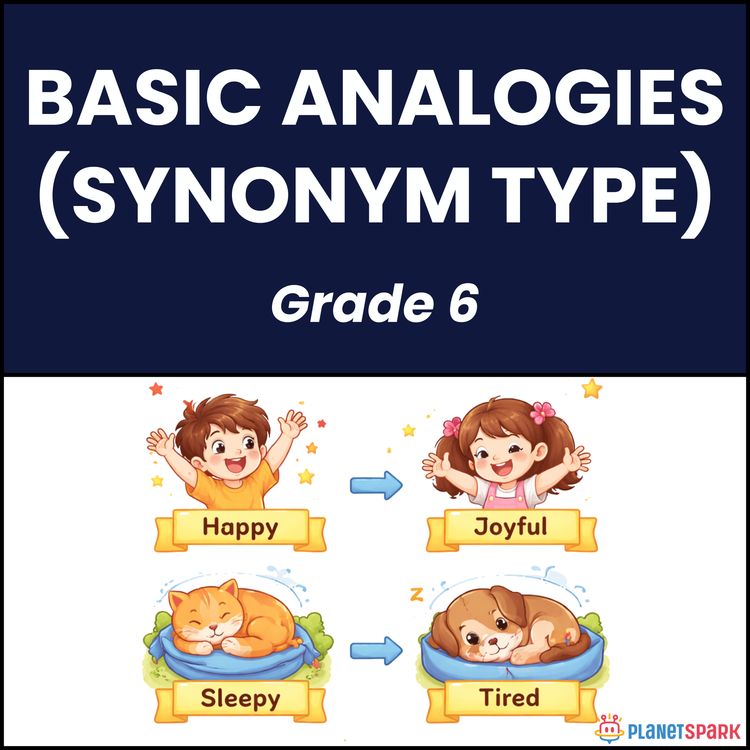
Class 6 Grammar Worksheet on Synonym Analogies
Synonym Power Play: Mastering Synonym Analogies for Class 6
This Grade 6 worksheet focuses on building a strong understanding of synonym analogies, an essential vocabulary and reasoning skill in English grammar. Through engaging and structured exercises, students learn how words relate to each other based on similar meanings.
Why Synonym Analogies Matter in Grammar?
Synonym analogies help learners expand vocabulary and understand word relationships. For Grade 6 students, this topic is important because:
1. It strengthens vocabulary by introducing similar-meaning words.
2. It improves logical reasoning and comparison skills.
3. It enhances reading comprehension and writing clarity.
4. It prepares students for advanced grammar and verbal reasoning tasks.
What’s Inside This Worksheet?
This worksheet includes five grammar-rich activities that build mastery in synonym analogies:
Exercise 1 – True or False
Students identify whether each statement about synonym analogies is correct or incorrect, reinforcing conceptual understanding.
Exercise 2 – Match the Columns
Students match words with their correct synonyms, helping them recognize word pairs and strengthen vocabulary connections.
Exercise 3 – Fill in the Blanks
Students complete synonym analogies by selecting appropriate words that match meaning relationships.
Exercise 4 – Multiple Choice Questions
Students choose the correct synonym to complete each analogy, enhancing accuracy and decision-making skills.
Exercise 5 – Sentence Rewriting
Students correct incorrect synonym analogies by replacing highlighted words with suitable synonyms, improving grammar precision.
This worksheet builds confidence in vocabulary usage while making learning interactive and meaningful for young learners.
Answer Key
Exercise 1 – True or False
1. True
2. False
3. True
4. True
5. False
6. True
7. False
8. True
9. True
10. False
Exercise 2 – Match the Columns
1. Start : Begin :: Finish : End
2. Glad : Happy :: Mad : Angry
3. Small : Tiny :: Large : Huge
4. Fast : Quick :: Slow : Sluggish
5. Leap : Jump :: Drop : Fall
6. Scared : Afraid :: Brave : Courageous
7. Shout : Yell :: Whisper : Murmur
8. True : Correct :: False : Wrong)
9. Neat : Tidy :: Messy : Sloppy
10. Rich : Wealthy :: Poor : Needy
Exercise 3 – Fill in the Blanks
1. Hideous (or Unattractive, Awful)
2. Inquire (or Question)
3. Noisy (or Deafening, Boisterous)
4. Rescue (or Keep, Preserve)
5. Law (or Regulation, Guideline)
6. Packed (or Full, Jammed)
7. Repair (or Mend, Restore)
8. Permit (or Let, Authorize)
9. Impolite (or Disrespectful)
10. Peculiar (or Strange, Unusual)
Exercise 4 – Multiple Choice Questions
1. d (Assist)
2. c (Leap)
3. a (Throw)
4. b (Ordinary)
5. b (Choose)
6. d (Middle)
7. a (Present)
8. c (Ruin)
9. a (Noisy)
10. b (Aim)
Exercise 5 – Sentence Rewriting (Corrected)
1. Just as smart is to clever, the word funny is to amusing (or hilarious, comical).
2. If start is to begin, then the word finish is to end (or stop, conclude).
3. Since big is to huge, the word small is to tiny (or little, miniature).
4. Like fast is to quick, the word slow is to sluggish (or unhurried).
5. Just as sick is to ill, the word tired is to exhausted (or sleepy, drained).
6. If rich is to wealthy, then the word poor is to needy (or broke, penniless).
7. Since neat is to tidy, the word messy is to sloppy (or untidy, disorganized).
8. Like happy is to glad, the word sad is to unhappy (or sorrowful, depressed).
9. Just as hard is to difficult, the word easy is to simple (or effortless).
10. If brave is to fearless, then the word scared is to terrified (or afraid, fearful).
Boost your child’s vocabulary and reasoning skills with expert-designed synonym analogy practice today.
Book a free trial!
Frequently Asked Questions
Synonym analogies are comparisons between words that have similar meanings, helping students expand their vocabulary and understand word relationships.
A simple examples include "happy:joyful," "fast:quick," and "strong:powerful," where students learn how synonyms can be used interchangeably in sentences.
Synonyms show words with similar meanings, while antonyms highlight opposite meanings, teaching different word relationships.