
Class 6 Grammar Worksheet on Relative Clauses

Class 6 Grammar Worksheet on Relative Clauses
Relative Clauses (Restrictive vs Non-Restrictive): Grammar Mastery for Grade 6
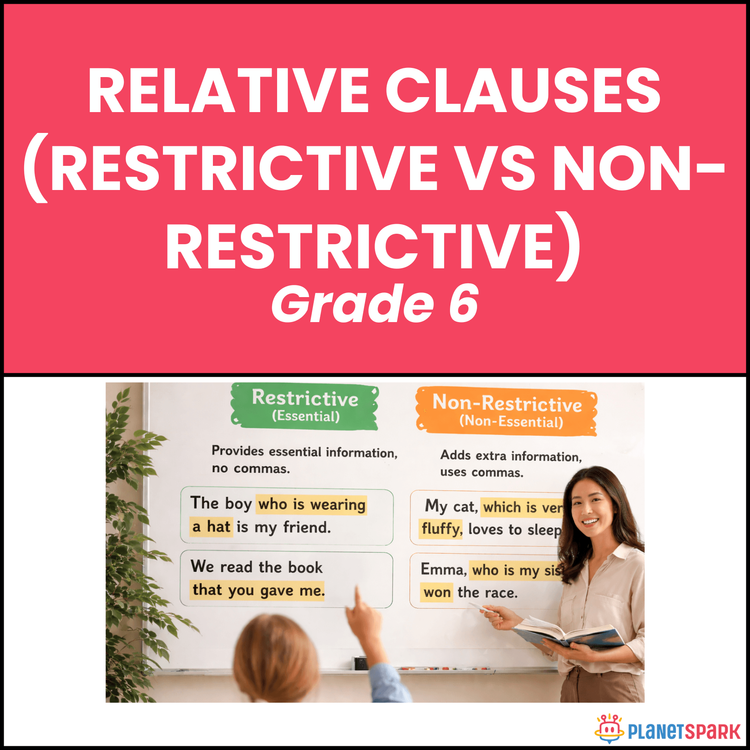
This Grade 6 worksheet helps students understand the difference between restrictive and non-restrictive relative clauses. The exercises focus on identifying and using these clauses in various sentence structures, teaching students to modify and elaborate on information within sentences.
The worksheet includes a variety of tasks, such as underlining restrictive and non-restrictive clauses, choosing the correct punctuation for relative clauses, and rewriting sentences to incorporate both types of relative clauses. These tasks allow students to grasp how each type of clause functions and how punctuation plays a key role in clarifying sentence meaning.
By mastering these clauses, students will be able to craft clearer, more detailed sentences in both written and spoken English. This worksheet is an ideal tool for building confidence in using relative clauses correctly.
Unlock your child’s grammar skills with this essential worksheet on relative clauses today!
Book a free trial!
🔹 Answer Key
Exercise 1 – Identify Restrictive or Non-Restrictive Clauses
1. Non-restrictive
2. Restrictive
3. Non-restrictive
4. Non-restrictive
5. Non-restrictive
6. Restrictive
7. Non-restrictive
8. Restrictive
9. Restrictive
10. Non-restrictive
Exercise 2 – Choose the Correct Punctuation for the Relative Clause
1. a) My brother, who lives abroad, is visiting.
2. a) The book that I bought is new.
3. a) She gave me the dress that she made.
4. b) The house, which was built in 1980, is still standing.
5. a) I have a dog that barks loudly.
6. a) The teacher, who is kind, helped me.
7. b) The car that I drive is old.
8. a) The city, which is very crowded, is hard to navigate.
9. a) I know a man who works here.
10. a) The movie, which was released last year, won several awards.
Exercise 3 – Apply the Rule to Rewrite Each Sentence Correctly
1. She missed the train because she was late. (Simple Past Tense)
2. The woman who lives next door is very friendly. (Present Continuous Tense)
3. The book that I read was interesting. (Future Simple Tense)
4. The dog, which is very friendly, loves to play. (Simple Past Tense)
5. The man who helped me was kind. (Simple Present Tense)
6. I met a teacher who speaks French. (Simple Past Tense)
7. The car, which was expensive, broke down. (Future Simple Tense)
8. I have a friend who enjoys reading. (Simple Present Tense)
9. The restaurant, where we had dinner, was amazing. (Simple Past Tense)
10. The child, who is very talented, won the competition. (Future Simple Tense)
Exercise 4 – Fill in the Blanks with Correct Punctuation for the Relative Clauses
1. who lives in London
2. that I drive
3. who helped me
4. what happened
5. why he left
6. where we met
7. why you were late
8. that she gave me
9. where the meeting will be
10. that she is coming
Exercise 5 – Write a Short Paragraph Using Both Restrictive and Non-Restrictive Relative Clauses
(Answers may vary, sample: "My friend, who loves to travel, told me about a new place she visited. The place that she recommended was beautiful. We stayed there because it was peaceful, and it had everything we needed. The hotel, which was near the beach, offered great food. I’m glad I took her advice to visit the place.")
Help your child master restrictive and non-restrictive relative clauses today with a Free 1:1 Grammar Skills Trial Class at PlanetSpark.
Book a free trial!
🔹 FAQs
What are restrictive and non-restrictive relative clauses, and why are they important for Grade 6 learners? Restrictive relative clauses provide essential information, while non-restrictive clauses offer extra information that isn’t crucial to the main meaning. For Grade 6 students, learning the difference is crucial because:
1. Restrictive clauses define or limit the noun they modify.
2. Non-restrictive clauses provide additional, non-essential details.
3. Proper punctuation helps to distinguish between the two, affecting meaning and clarity.
How do the exercises in this worksheet help my child with relative clauses? The worksheet includes tasks where students identify restrictive and non-restrictive clauses, choose the correct punctuation, and rewrite sentences. These exercises build their ability to recognize and use both types of relative clauses, which enhances their writing clarity and complexity.
Why is mastering relative clauses important for my child's grammar development? Understanding relative clauses helps students create detailed and informative sentences. It enables them to express more complex ideas clearly and efficiently, improving their overall writing skills and preparing them for higher-level writing tasks.
Frequently Asked Questions
A restrictive relative clause provides essential information about the noun it modifies, while a non-restrictive relative clause adds extra, non-essential information, usually separated by commas.
Commas are used with non-restrictive relative clauses to show that the information is extra and not necessary to identify the noun. Without commas, the clause is restrictive and essential to the meaning of the sentence.
Students can practice by identifying whether the clause is providing essential details (restrictive) or extra information (non-restrictive), and use commas appropriately for non-restrictive clauses.