
Class 7 Worksheet on Technical and General Words

Class 7 Worksheet on Technical and General Words
Words in Context: Technical vs General Vocabulary for Class 7
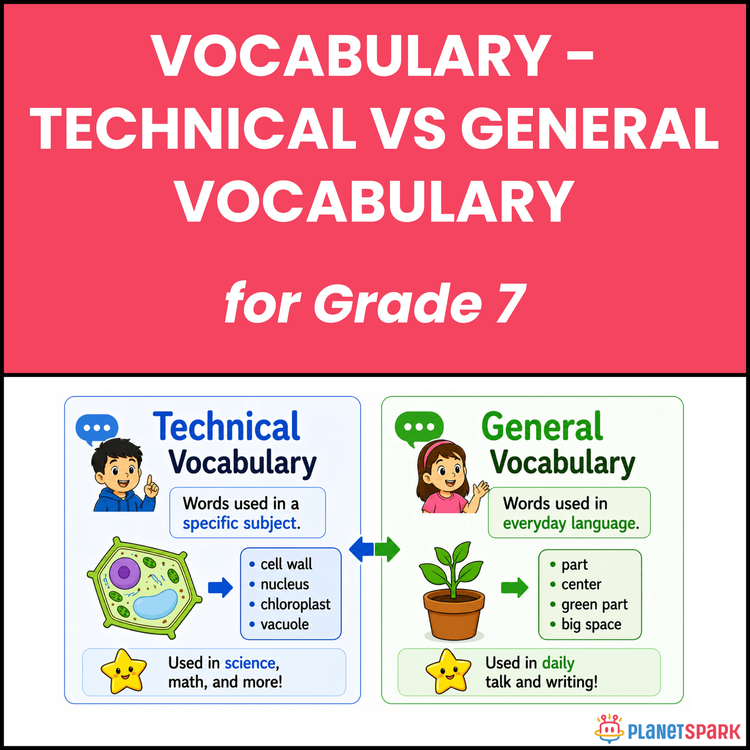
This Grade 7 worksheet focuses on helping students clearly distinguish between technical vocabulary used in specific subjects and general vocabulary used in everyday communication. Through carefully designed exercises, learners explore words like “photosynthesis,” “gravity,” and “hypothesis” alongside common words like “chair,” “food,” and “walk,” building a strong understanding of how context shapes meaning.
Why Technical vs General Vocabulary Matters in Grammar?
Understanding the difference between technical and general vocabulary is essential for accurate communication. For Grade 7 learners, this topic is important because:
1. It helps students identify subject-specific words used in science and academic contexts.
2. It improves clarity in both formal writing and daily conversations.
3. It builds awareness of how context changes meaning.
4. It strengthens comprehension across subjects like science, literature, and social studies.
What’s Inside This Worksheet?
This worksheet includes five structured exercises that build conceptual clarity and application:
🧠 Exercise 1 – True or False
Students evaluate statements about technical and general vocabulary, such as whether technical words are subject-specific or if general words are used in daily conversations (page 3).
✏️ Exercise 2 – Sort the Words
Learners classify a mix of subject-specific and everyday words into technical and general vocabulary categories (page 4).
📋 Exercise 3 – Fill in the Blanks
Students complete sentences using the correct word from given options, applying vocabulary in real-life and scientific contexts (page 5).
📝 Exercise 4 – Multiple Choice Questions
MCQs test understanding of definitions, usage, and context of technical and general words, including identifying science-related vocabulary and everyday language (pages 6–7).
🔁 Exercise 5 – Sentence Rewriting
Students correct incorrect statements to reinforce accurate understanding of vocabulary concepts and usage (page 8).
✅ Answer Key (For Parents & Educators)
Exercise 1 – True or False
1. True
2. True
3. True
4. False
5. False
6. False
7. True
8. True
9. False
10. True
Exercise 2 – Sort the Words
Technical Vocabulary: photosynthesis, molecule, gravity, evaporation, hypothesis, energy, experiment
General Vocabulary: walk, friend, house, book, food, chair, citizen, run
Exercise 3 – Fill in the Blanks
1. photosynthesis
2. chair
3. hypothesis
4. general
5. evaporation
6. hypothesis
7. run
8. gravity
9. experiment
10. food
Exercise 4 – Multiple Choice Questions
1. a) words for specific subjects
2. d) house
3. c) photosynthesis
4. c) it helps understand meaning
5. c) experiment
6. d) general
7. d) walk
8. c) experiment
9. c) photosynthesis
10. b) to be specific and accurate
Exercise 5 – Sentence Rewriting
1. Technical words are used in specific subjects.
2. General words are used in everyday language, not only textbooks.
3. Not every long word is a technical word.
4. “Chair” is a general word, not a technical science word.
5. Context helps us understand meaning.
6. Scientists use technical vocabulary.
7. “Photosynthesis” is a technical word.
8. General words are useful in school and daily life.
9. Experiment means testing ideas through practical methods.
10. Technical vocabulary makes ideas more precise.
Help your child confidently identify and use subject-specific and everyday vocabulary with clarity and accuracy.
🔖Book a free trial!
Frequently Asked Questions
They teach students when to use subject-specific terms and when simple everyday words are more suitable in communication and comprehension.
Technical words belong to specific subjects like science, while general words are used in everyday speaking, reading, and writing tasks.
They should read both textbooks and daily passages, noticing where formal subject words and simple words are used differently.