
Class 7 Worksheet on Prepositions of Time & Place

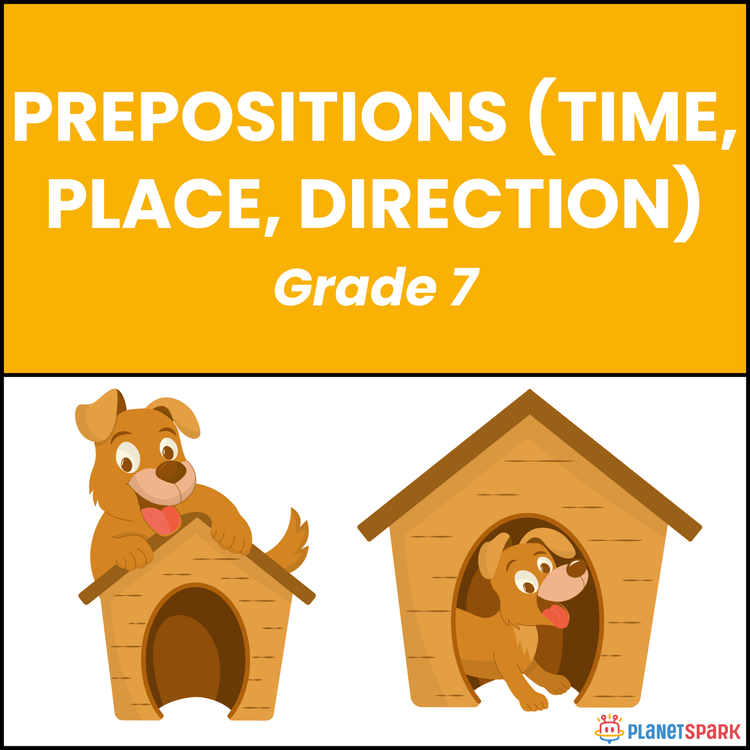
Class 7 Worksheet on Prepositions of Time & Place
Location and Time: Mastering Prepositions for Class 7
This Grade 7 worksheet provides a comprehensive review of Prepositions of Time, Place, and Direction. Students will practice identifying and using correct prepositions like *in, on, at, towards, into* to describe when and where events happen. With a mix of multiple-choice questions, sentence correction, and paragraph completion, this resource strengthens spatial and temporal understanding in English grammar.
Why Prepositions Matter in Grammar?
Prepositions are small words with a big job: they tell us where things are and when things happen. For Grade 7 learners, this topic is important because:
1. They provide essential context regarding time and location.
2. They help avoid ambiguity in descriptive writing.
3. Correct usage distinguishes between specific times (at 5 pm) and general periods (in May).
4. They are vital for giving and following directions accurately.
What’s Inside This Worksheet?
This worksheet includes five grammar-rich activities that build fluency with prepositions:
Exercise 1 – Choose the Correct Preposition
Students identify the correct preposition to complete sentences about time, place, and direction. Example: “The train is heading __________ Delhi.” (Answer: towards)
Exercise 2 – True or False
Learners determine the validity of statements regarding the rules of preposition usage, such as specific times versus days of the week.
Exercise 3 – Fill in the Blanks
Students complete general grammar rules regarding prepositions, reinforcing their understanding of usage patterns (e.g., “We use ‘at’ for __________ times of day.”).
Exercise 4 – Correct the Preposition
Students identify the incorrect preposition in a sentence and rewrite it with the correct one. Example: “She will arrive in Monday” → “She will arrive on Monday.”
Exercise 5 – Paragraph Writing
Students fill in the blanks in a travel story using appropriate prepositions of time, place, and direction, ensuring the narrative is geographically and chronologically accurate.
Answer Key (For Parents & Educators)
Exercise No. 1
1. b) Rahul wakes up early daily.
2. a) The book is on the wooden study table.
3. b) Neha walked towards the busy market.
4. b) The school reopens on the fifteenth.
5. a) Anjali lives in the city of Lucknow.
6. a) The train is heading towards Delhi.
7. b) We celebrate Republic Day on 26 Jan.
8. a) The cat is sleeping above the bed now.
9. a) The bird flew into the open cage.
10. b) Arjun studies at night every single day.
Exercise No. 2
1. True
2. True
3. True
4. True
5. True
6. False ("On" is used for specific days, not longer periods like months)
7. False ("At" is used for specific points, "In" is used before the names of large cities)
8. False ("Into" shows movement from outside to inside)
9. True
10. False ("Between" is typically used for two things or places, not three or more)
Exercise No. 3
1. We use 'at' for specific times of day.
2. We use 'in' for months and years.
3. We use 'on' for days and dates.
4. We use 'in' for cities and countries.
5. We use 'at' for specific points like bus stops.
6. We use 'on' for surfaces like tables.
7. 'Towards' shows movement in a certain way.
8. 'Into' indicates movement inside something.
9. We use 'at' with times like noon.
10. 'Under' is a preposition of place.
Exercise No. 4
1. She will arrive on Monday morning soon.
2. Rahul lives in Mumbai with his family.
3. The book is on the table by the window.
4. The cat jumped off the wooden table.
5. We go to school by the bus every day.
6. Anjali was born in 2015 in Delhi city.
7. He walked into the room and sat down.
8. Neha goes to school by the bus daily.
9. The ball rolled into the deep hole quickly.
10. The shop is at the end of the road.
Exercise No. 5
Answers may vary. (Suggested answers based on context: Last summer, Aarav travelled to Jaipur with his entire family... They started the long journey at five in the morning... The train arrived at the station exactly... Aarav sat at the window seat... They reached Jaipur on Monday afternoon... The hotel was located in the old city area... In the cool evening... Aarav walked towards the grand gateway... The guide pointed to the intricate carvings... They returned to the hotel...)
Boost your child's directional and time vocabulary with a Free 1:1 Grammar Trial Class at PlanetSpark.
Book a free trial!
Frequently Asked Questions
Prepositions of time show when something happens (e.g., “at,” “on”), and prepositions of place show where something happens (e.g., “in,” “at”).
By practicing with simple sentences and understanding when and where actions occur.
They help students convey the relationship between actions and time or location clearly.