
Class 4 Homonyms Bat and Bank Grammar Worksheet

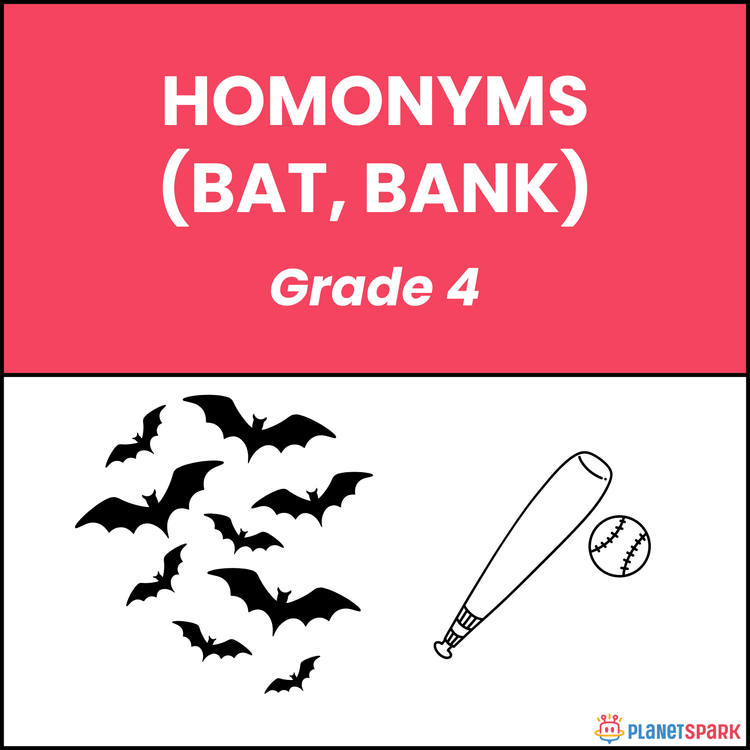
Class 4 Homonyms Bat and Bank Grammar Worksheet
One Word, Many Meanings: Homonyms (Bat, Bank) for Class 4
This Grade 4 worksheet introduces students to the fascinating world of homonyms — words that are spelled the same and sound the same, but carry completely different meanings depending on how they are used in a sentence. Featuring everyday homonyms like bat, bank, bark, jam, light, ring, watch, date, fair, and park, this resource helps Class 4 learners understand that context is the key to unlocking the correct meaning of a word.
Why Do Homonyms Matter in Grammar?
Understanding homonyms is an essential vocabulary and comprehension skill for Grade 4 students. It is important because:
1. It teaches students that the same word can have multiple meanings, sharpening reading comprehension.
2. It builds contextual thinking skills — students learn to look at the full sentence before deciding a word's meaning.
3. It improves writing quality by helping students choose and use words with precision.
4. It prepares learners for higher-order language tasks involving inference, interpretation, and vocabulary depth.
What's Inside This Worksheet?
This worksheet includes five well-structured activities that build homonym recognition and meaning identification across different contexts:
Exercise 1 – Match the Following
Students match each homonym on the left to a meaning clue word from the pool on the right. For example, bank matches with shore or traffic, bat matches with club or animal, and light matches with lamp. This activity introduces the concept of multiple meanings in a simple, visual format.
Exercise 2 – Sort the Words
Students sort given word pairs into two groups — Homonym (same spelling, different meaning) and Not Homonym. Pairs like bat/bat, bank/bank, bark/bark, wave/wave, light/light, and match/match are homonyms, while pairs like knight/night, bear/bare, hair/hare, and sea/see are homophones and go into the Not Homonym group. This critical thinking task sharpens the distinction between homonyms and homophones.
Exercise 3 – Fill in the Blanks
Students select the correct meaning word from a given pair to describe how a homonym is used in each sentence. With 10 sentences covering bank, bat, bark, jam, and light, this exercise trains learners to identify meaning from context accurately.
Exercise 4 – Multiple Choice Questions
Students choose the correct meaning of a homonym used in a specific context from four options. With 10 questions across two pages, this activity builds meaning identification skills in a test-style format suitable for exam preparation.
Exercise 5 – Sentence Rewriting
Students rewrite 10 sentences in which homonyms have been used with incorrect meanings, replacing the wrong word or phrase with the correct one. This error-correction task challenges learners to think deeply about word meaning and context.
Answer Key (For Parents & Educators)
Exercise 1 – Match the Following
bank → shore
bat → club
bark → tree
jam → traffic
light → lamp
ring → circle
watch → look
date → fruit
fair → show
park → park (green space)
Exercise 2 – Sort the Words
Homonym:
bat/bat
bank/bank
bark/bark
wave/wave
light/light
match/match
left/left
Not Homonym:
peace/piece
knot/not
fair/fare
flower/flour
knight/night
bear/bare
hair/hare
sea/see
Exercise 3 – Fill in the Blanks
1. shore (shore / money)
2. money (money / shore)
3. club (club / animal)
4. animal (animal / club)
5. bark (bark / sound)
6. sound (sound / bark)
7. traffic (traffic / spread)
8. spread (spread / traffic)
9. lamp (lamp / club)
10. not heavy (not heavy / lamp)
Exercise 4 – Multiple Choice Questions
1. c) shore
2. d) money
3. b) club
4. a) animal
5. d) tree
6. a) sound
7. c) traffic
8. b) spread
9. c) lamp
10. d) not heavy
Exercise 5 – Sentence Rewriting
1. Rahul sat on the shore (river bank) of Yamuna.
2. Diya saved coins in the bank (money bank).
3. Ravi hit the ball with his cricket bat.
4. A flying bat came out of the old tree at dusk.
5. The tree bark was thick and brown.
6. The dog's bark was loud near the gate.
7. There was a traffic jam on the road.
8. Sana spread strawberry jam on her morning bread.
9. Rohan tied a knot in his shoelace.
10. The puppy made a loud bark at the stranger.
Help your child explore the many meanings of words with a Free 1:1 English Vocabulary and Grammar Trial Class at PlanetSpark — because understanding words in context is the foundation of confident reading and writing!
Frequently Asked Questions
Homonyms are words that have the same spelling or sound but different meanings, such as bat (animal) and bank (place for money).
They sound or look the same, but the context changes their meaning.
Encouraging children to use them in different sentences based on context will improve understanding.