
Class 4 Common Homophones to/too/two Grammar Sheet

Class 4 Common Homophones to/too/two Grammar Sheet
One Sound, Many Meanings: Common Homophones (to/too/two) for Class 4
This Grade 4 worksheet dives into the world of homophones — words that sound the same but have different spellings and meanings. While the focus is on the classic trio to, too, and two, this worksheet also covers a wide range of other common English homophones such as see/sea, knight/night, tail/tale, flour/flower, and more. Through five engaging activity types, students build the reading and writing accuracy needed to use the right word every time.
Why Homophones (to/too/two) Matter in Grammar?
Homophones are one of the trickiest aspects of English spelling. For Grade 4 learners, this topic is important because:
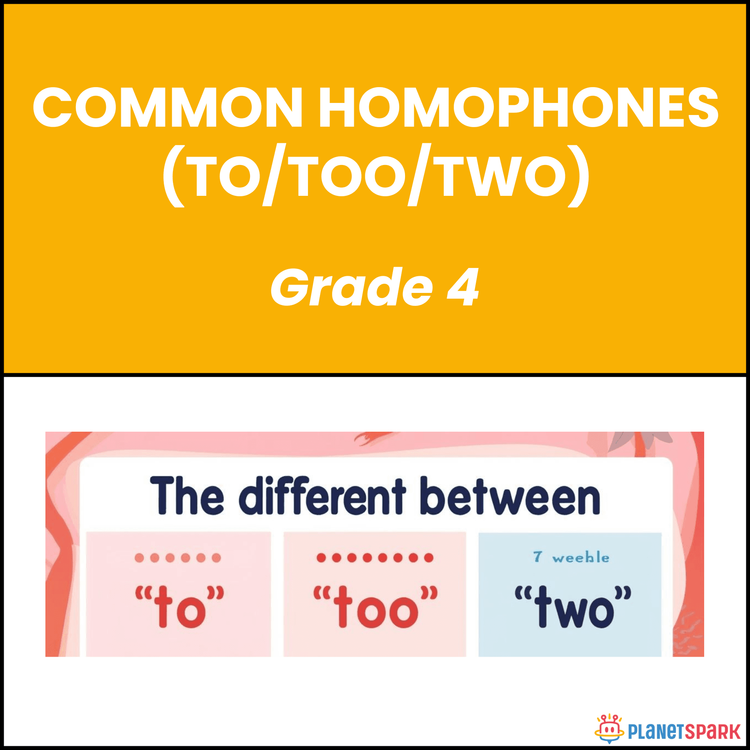
1. To is a preposition or part of an infinitive — "I want to go."
2. Too means also or excessively — "She came too." / "It is too hot."
3. Two is the number 2 — "I have two books."
4. Beyond to/too/two, English is filled with common homophones that appear in everyday reading and writing.
5. Knowing homophones prevents spelling errors and improves reading comprehension.
What's Inside This Worksheet?
This worksheet includes five carefully structured activities that build homophone recognition and usage:
Exercise 1 – Match the Following
Students match each word on the left to its correct homophone on the right from a broader set of common homophones including see/sea, blue/blew, one/won, right/write, dear/deer, peace/piece, flour/flower, tail/tale, hole/whole, and knight/night.
Exercise 2 – Sort the Words
Students sort word pairs into two groups — Homophones and Non-Homophones. This activity trains students to identify which pairs sound alike versus which pairs are simply different words with no sound connection.
Exercise 3 – Fill in the Blanks
Students select the correct homophone from a given pair to complete each sentence meaningfully. This activity covers a wide range of pairs including allowed/aloud, two/too, made/maid, ate/eight, by/buy, heel/heal, knows/nose, pair/pear, week/weak, and four/for.
Exercise 4 – Multiple Choice Questions
Students choose the correct homophone from four options. This exercise uses both sentence context and knowledge of specific homophone pairs to guide the correct answer, covering pairs like see/sea, to/two, one/won, right/write, flower/flour, night/knight, dear/deer, peace/piece, tail/tale, and hole/whole.
Exercise 5 – Sentence Rewriting
Students identify and correct the wrong homophone in each sentence by rewriting it with the correct word. This proofreading task brings together all the homophone knowledge practised in earlier exercises.
Answer Key (For Parents & Educators)
Exercise 1 – Match the Following
1. see → sea
2. blue → blew
3. one → won
4. right → write
5. dear → deer
6. peace → piece
7. flour → flower
8. tail → tale
9. hole → whole
10. knight → night
Exercise 2 – Sort the Words
Homophones:
1. their/there
2. two/too
3. whole/hole
4. rain/reign
5. plain/plane
6. knight/night
7. fare/fair
8. mail/male
9. toad/towed
10. weight/wait
Non Homophones:
1. cat/dog
2. right/wrong
3. good/bad
4. seen/saw
5. ball/bowl
Exercise 3 – Fill in the Blanks
1. allowed
2. two
3. maid
4. ate
5. buy
6. heal
7. knows
8. pair
9. weak
10. four
Exercise 4 – Multiple Choice Questions
1. c) see
2. b) two
3. a) one
4. b) write
5. c) flour
6. d) knight
7. b) deer
8. a) piece
9. a) tale
10. d) hole
Exercise 5 – Sentence Rewriting
1. They're going to the match.
2. I have two pencils in my bag.
3. The rabbit found a hole in the ground.
4. Reign of the king lasted long.
5. The plane took off fast.
6. The knight wore shining armor.
7. The fare price was high.
8. He sent a mail to his friend.
9. The car was towed away.
10. Please wait for your turn.
Help your child stop second-guessing homophones — sign them up for a Free 1:1 English Trial Class at PlanetSpark and turn tricky word pairs into easy wins.
Frequently Asked Questions
To refers to direction, too means also, and two is a number, but they all sound the same.
Children often focus on pronunciation instead of context, leading to spelling mistakes.
Encouraging sentence writing and highlighting the meaning of each word helps solidify understanding.