
Class 4 Common Homophones there/their/they’re Sheet

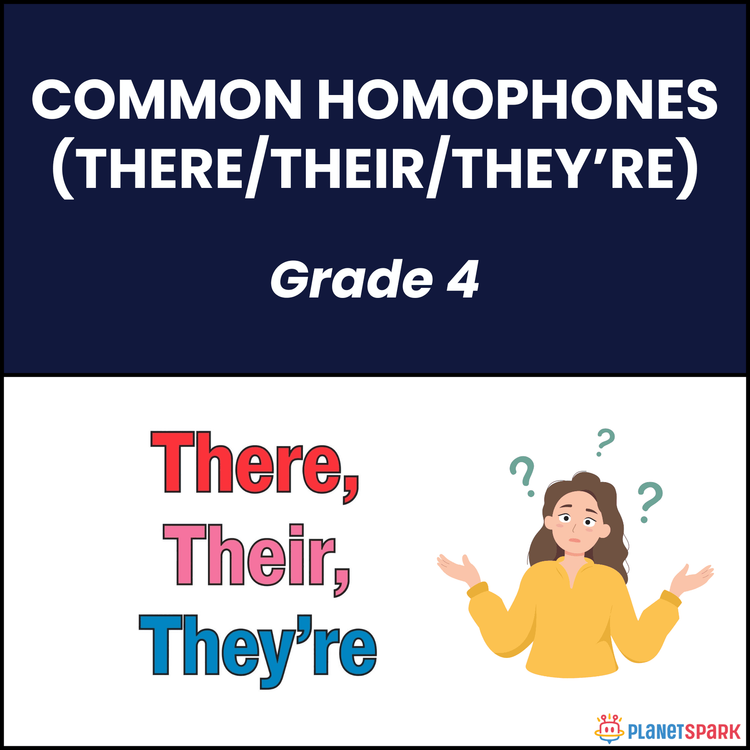
Class 4 Common Homophones there/their/they’re Sheet
Sound Alike, Mean Different: Common Homophones (there/their/they're) for Class 4
This Grade 4 worksheet focuses on one of the most commonly confused sets of homophones in the English language — there, their, and they're. Even though all three words sound exactly the same, each one has a completely different meaning and use. This worksheet helps young learners understand and confidently distinguish between there (a place), their (showing possession), and they're (a contraction of they are) through five fun and varied activity types.
Why Homophones (there/their/they're) Matter in Grammar?
These three words are among the most frequently misused in written English. For Grade 4 learners, this topic is important because:
1. There refers to a place or introduces a sentence — "There is a park nearby."
2. Their shows ownership by a group — "Their books are on the shelf."
3. They're is a contraction of they are — "They're going to school."
4. Mixing them up is one of the most common writing errors even among adults.
5. Getting these right builds stronger spelling, writing, and proofreading skills.
What's Inside This Worksheet?
This worksheet includes five carefully designed activities that build confidence with this tricky homophone trio:
Exercise 1 – Match the Following
Students match each word (there, their, they're) to its correct use in the sentence fragments on the right. This activity helps students associate each word with its specific grammatical role — place, possession, or contraction.
Exercise 2 – Sort the Words
Students sort given word pairs into two groups: Homophone and Not Homophone. This activity builds awareness of what makes two words homophones and sharpens their phonetic and semantic understanding.
Exercise 3 – Fill in the Blanks
Students choose the correct word from a pair — there, their, or they're — to complete each sentence. This activity directly tests their ability to apply each word in a real sentence context.
Exercise 4 – Multiple Choice Questions
Students select the right option from four choices to complete each sentence correctly. The four-option format challenges students to think carefully and eliminate wrong answers confidently.
Exercise 5 – Sentence Rewriting
Students rewrite incorrectly written sentences using the correct homophone. This error-correction task helps students develop strong proofreading skills and reinforces all three uses in a practical writing context.
Answer Key (For Parents & Educators)
Exercise 1 – Match the Following
1. there → is no such thing.
2. their → house is blue
3. they're → here to play.
4. there → are many peas.
5. their → dog is barking
6. they're → going today.
7. there → was his pen
8. their → fruit is better.
9. they're → very nice.
10. there → coming over.
Exercise 2 – Sort the Words
Homophone:
1. they're/their
2. their/they are
3. they're/they are
4. their/there
5. there/they are
6. they're/there
7. there/wear
8. their/fair
Not Homophone:
1. their/pair
2. there/care
3. there/three
4. their/chair
5. there/tear
6. their/here
7. they're/are
Exercise 3 – Fill in the Blanks
1. there
2. their
3. They're
4. there
5. their
6. They're
7. there
8. their
9. They're
10. there
Exercise 4 – Multiple Choice Questions
1. d) there
2. d) their
3. a) there
4. b) there
5. c) their
6. a) there
7. a) there
8. b) their
9. a) they're
10. c) there
Exercise 5 – Sentence Rewriting
1. There is a park near our school.
2. The boys left their bags in class.
3. They're going to the market now.
4. Is the teacher sitting there today?
5. Put the books in their cupboard.
6. I think they're playing kho kho now.
7. The toys are over there on the floor.
8. Their shoes are wet from rain.
9. Their parents came to the meeting.
10. They're going to Lucknow tomorrow.
Stop confusing words that sound the same — enroll your child in a Free 1:1 English Trial Class at PlanetSpark and help them write with clarity and confidence.
Frequently Asked Questions
There shows place, their shows possession, and they’re is a contraction of they are.
They sound the same but have different meanings, making it challenging for young learners.
Practice using them in context and provide visual aids, such as pictures or charts, for each form.